How Many Eggs Does a Chicken Lay in a Year?
Are you curious about how many eggs your chicken can lay in a year? Many backyard chicken keepers wonder if their hens are producing enough or if they’re getting the most out of their flock. You’re not alone—understanding egg production can be confusing, especially with so many factors at play.
A hen can lay between 250 and 300 eggs in a year during her peak years, usually the first or second year of laying. Factors like breed, nutrition, lighting, and environment greatly influence her output.
Highest-yield breeds like White Leghorns produce near the top of this range, while older hens generally lay fewer eggs. As she ages beyond 3 to 4 years, egg production declines.
Keep exploring to find out how to maximize her laying potential throughout her life.
Key Takeaways
- High-yield breeds like White Leghorns can lay approximately 280-300 eggs a year during their peak years.
- Egg production usually hits its highest in the first one or two years and then starts to decline.
- Most hens lay around 1,500 to 2,500 eggs over their lifetime, but this can vary depending on the breed and how they’re managed.
- Seasonal changes and lighting play a big role in how many eggs a hen lays each year.
- Using artificial lighting can help keep production steady, especially in shorter days.
- As hens get older, especially after 3 or 4 years, their egg production tends to decrease because of aging and physical signs of decline.
How Many Eggs Does a Chicken Laid During Its Peak Year?
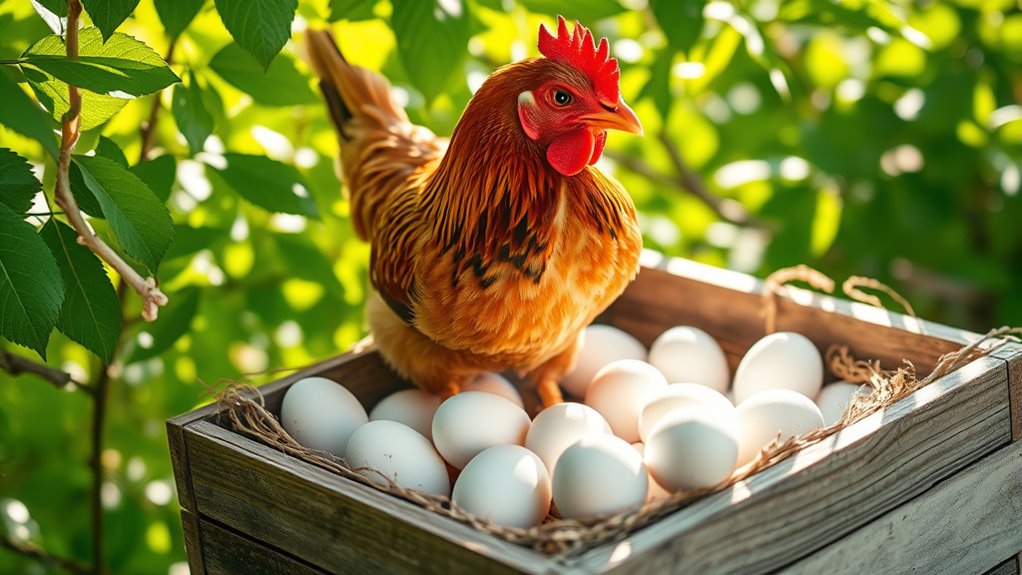
Have you ever wondered how many eggs a chicken can lay in its best year? During peak production, laying hens can produce between 250 to 300 eggs per year, depending on breed and management.
Top commercial breeds, like White Leghorns, often reach the upper end of this range, laying around 280 to 300 eggs in their best year. The peak egg-laying period usually occurs during a hen’s first or second year of laying, when production is at its highest.
Environmental factors such as light, nutrition, and stress levels notably influence this output. During this time, some hens can lay nearly one egg per day. Overall, the number of eggs per year varies, but peak production showcases the impressive capacity of laying hens to produce eggs efficiently.
What Factors Most Affect a Hen’s Annual Egg Output?
Your hen’s breed really influences how many eggs she can lay each year. Some breeds can lay nearly 300 eggs annually, so choosing the right breed makes a big difference.
Proper nutrition is also key. Make sure she gets enough calcium and protein to keep her egg production steady and her shells healthy.
Additionally, consistent lighting and a comfy environment help maximize her output throughout the year. It’s all about creating the right conditions for her to thrive.
Breed Selection Influence
The breed of a hen plays an essential role in determining its annual egg output, as different breeds naturally lay varying amounts of eggs. Your choice of breed directly influences egg production because genetics control key traits like laying frequency, egg size, and overall productivity.
For example, breeds like White Leghorns can lay up to 300 eggs per year, while breeds like Polish hens produce around 100 eggs annually. High-yielding breeds are often selectively bred to maximize egg output, but this may sometimes impact their health.
The reproductive traits inherent in each breed, such as age at first laying and the length of the laying cycle, also greatly affect how many eggs a hen can produce in a year. So, choosing the right breed is key to hitting your egg production goals.
Nutrition and Diet Quality
Proper nutrition is essential for maximizing a hen’s egg-laying potential, as a well-balanced diet provides the necessary nutrients to support consistent production. Key nutrients like calcium and protein play a crucial role in this process.
Calcium is indispensable for strong eggshells, and deficiencies can lead to weak shells or reduced egg production. Protein, especially amino acids, supports the development of eggs and overall health.
Commercial diets formulated for laying hens typically contain around 16-20% protein and added calcium to optimize egg yield. Poor diet quality or inconsistent feeding practices can decrease egg size, weaken shells, and lower production rates.
Ensuring your hens receive proper nutrition with adequate calcium and protein is fundamental to maintaining high egg output throughout the year.
Lighting and Environment
Lighting and environment play vital roles in determining a hen’s annual egg output. Adequate lighting, around 16 hours daily, is crucial for keeping egg production steady throughout the year.
During winter, natural daylight shortens, which can cause a drop in egg laying. But you can make up for this with artificial lighting.
Poor housing conditions, like inadequate ventilation or overcrowding, stress hens and lower egg output.
Extreme temperatures, high humidity, or drafts also hurt a hen’s ability to lay eggs regularly.
A healthy environment supports good nutrition and parasite control, both of which are key for maximizing egg production.
How Does a Chicken’s Age Impact Egg-Laying Capacity?
As a chicken ages, its ability to lay eggs gradually declines, which affects how many eggs you can expect each year.
When chickens get older, their egg production drop becomes noticeable. After their first year, when laying capacity peaks at around 250 eggs annually, production starts to decline.
By age two, egg production drops to about 80% of what it was initially. As they reach three years old, their laying capacity can decrease to roughly 70%, with further drops as they grow older.
Most hens produce fewer eggs after 4-5 years, reflecting the natural aging process. Even though their egg-laying capacity diminishes, hens can still live several years beyond their peak production.
This ongoing decline shows how a chicken’s age directly impacts how productive they are, making age an important factor to consider in managing egg production.
How Do Breed and Climate Influence Egg Production?
Your choice of breed can really influence how many eggs a hen lays each year. Some breeds lay a lot more eggs than others, so picking the right one makes a big difference.
Climate also matters a lot, especially temperature and daylight. Extreme weather can cut down on egg production significantly.
Environmental stressors, like sudden weather changes or pollution, can also affect a hen’s ability to lay regularly. That’s why resilience to climate is an important factor when choosing your flock.
Breed-Specific Laying Patterns
Different chicken breeds vary a lot in how many eggs they lay each year, and their productivity depends on their genetics and environment.
Your choice of breed affects overall egg production. High-yield breeds like White Leghorns can lay up to 300 eggs annually, while breeds like Polish produce around 100 eggs per year.
Breed genetics influence when hens start laying, the size of their eggs, and their peak production times. Seasonal changes also matter; egg production often peaks in spring and early summer and drops in winter.
Some breeds are better suited to certain environments and maintain more consistent laying patterns. Understanding these breed traits helps you manage expectations and get the most eggs year-round.
Climate’s Impact on Production
Climate plays a crucial role in egg production because temperature extremes and seasonal changes directly affect hens’ laying habits. When temperatures are too hot or cold, hens become stressed, which reduces their egg-laying capacity.
Seasonal shifts, especially shorter daylight hours in winter, naturally decrease egg production unless you add supplemental lighting to mimic longer days. Humid or overly dry environments can also harm hen health, further lowering egg output.
Proper climate control—ventilation, temperature regulation, and humidity management—is essential to keep egg production steady regardless of external weather. Understanding how climate influences egg production helps you optimize conditions for your hens.
Here’s a quick overview:
| Climate Factor | Effect on Egg Production | Recommended Action |
|---|---|---|
| High temperatures | Decreases laying rates | Use cooling systems |
| Cold weather | Reduces laying | Provide heating or insulation |
| Humidity levels | Affects hen health | Maintain proper ventilation |
| Daylight hours | Controls natural laying | Use supplemental lighting |
Environmental Stress Effects
Breed and environmental conditions both play essential roles in how much eggs hens produce annually. Climate influences stress levels; extreme heat or cold can cause hens to reduce or temporarily stop laying eggs.
Poor ventilation and high humidity make environmental stress worse, leading to health issues and lower egg output. Seasonal changes, especially shorter daylight hours in winter, naturally decrease egg production unless artificial lighting is used.
Environmental stressors like predators, noise, and overcrowding also impact hens’ well-being, increasing anxiety and reducing egg production. High-yield breeds like White Leghorns are more sensitive to these stressors, while other breeds may tolerate challenges better.
Managing environmental conditions is key to minimizing stress and maximizing egg production throughout the year.
Does Seasonal Light and Climate Affect How Many Eggs My Hens Lay?
Seasonal changes in light and weather can really impact how many eggs your hens lay throughout the year. Shorter daylight hours in fall and winter naturally cause a drop in egg production, often by 30-50%.
Most hens need about 16 hours of light daily to keep laying at their best. That’s why many people use artificial lighting during colder months to help out.
Extreme cold or heat can stress your hens, leading to temporary decreases in egg output. Seasonal weather changes also affect their health and comfort, which can indirectly influence laying habits.
How Long Do Hens Usually Keep Laying Eggs?
Hens usually lay eggs consistently for about 2 to 3 years before their egg production drops significantly. During these years, most hens will keep laying eggs for up to 5 years, but their output gradually declines each year.
The peak laying period is typically in the first 1 to 2 years of a hen’s life, when egg production is at its highest. After 3 to 4 years, a hen’s egg production often drops to around 50-70% of what it was initially.
Many hens are retired or replaced once their egg-laying rate becomes too low to be economical, often around age 4 to 6. Knowing these laying years can help you plan for egg production and manage your hens better.
What Signs Show a Hen Is Nearing the End of Its Egg-Laying Life?
As a hen gets older and approaches the end of her laying years, you’ll notice she lays fewer eggs—usually fewer than three per week. The eggs may also become smaller or take on irregular shapes.
You might see some behavioral changes too, like her being less active or spending more time nesting. Physical signs often include worn combs and dull, scruffy feathers.
These signs are good indicators that it might be time to start thinking about her retirement.
Decreased Egg Production
When a hen nears the end of her egg-laying years, you’ll notice several clear signs that her productivity is declining. Decreased egg production is a common indicator of her aging, with her laying fewer eggs each week.
As her reproductive system ages, the decline becomes more obvious through irregular laying patterns, smaller eggs, and longer breaks without laying. You might also see a drop in shell quality, which points to reduced calcium reserves.
Over several months, the number of eggs she produces will noticeably decrease, showing she’s nearing the end of her productive years. Behavioral changes like decreased activity or increased brooding can also confirm her shift out of peak laying age.
Changes in Egg Quality
Declining egg quality is a clear sign that your hen is nearing the end of her productive years. As she ages, you’ll notice changes indicating a laying decline, especially in shell quality. These signs include smaller, less uniform eggs that vary in size.
Her shells may become thinner or more fragile, making eggs easier to break. You might also see irregular egg shapes or shells with cracks. Additionally, there will be a noticeable reduction in daily egg production, often falling below 50% of peak output.
These changes reflect her decreasing ability to produce high-quality eggs. As her laying decline continues, her eggs will become less consistent and shell quality will deteriorate. Monitoring these signs helps you understand her aging process and plan accordingly.
Behavioral and Physical Signs
Monitoring a hen’s behavior and physical appearance gives you helpful clues that her egg-laying years are coming to an end.
Signs of decreasing egg production include a noticeable drop in daily eggs over several weeks, often by 50-70%.
Physically, you might notice thinning or pale eggshells, irregular textures, or size differences.
Behaviorally, hens may show less nesting activity and lay eggs less often, indicating a decline in reproductive capacity.
Older hens often display less vigor, like reduced alertness and less social or exploratory behavior.
These signs together point to a decrease in overall egg output and can help you recognize when a hen is nearing the end of her laying life.
Knowing these cues allows you to adjust your care and expectations accordingly.
What Is the Expected Egg Production Over a Hen’s Entire Lifespan?
A hen’s total egg production over her lifespan depends on her breed, health, and management practices. Generally, you can expect her to lay between 1,500 and 2,500 eggs.
A hen typically lays 1,500 to 2,500 eggs over her lifespan, depending on breed and care.
As she ages, her egg production declines. In her first year, she can lay around 250–300 eggs.
In her second year, egg production drops to about 80% of the initial output, roughly 200 eggs.
By her third year, she produces just under 70% of her original eggs, about 175 eggs.
After 4-5 years, her annual egg count drops to approximately 150 eggs.
Over her 8-10 year lifespan, this adds up to the expected total egg production, which varies depending on breed and management.
How Can Proper Nutrition and Management Maximize Egg Production?
Providing proper nutrition and management is essential for maximizing your hens’ egg production. A balanced diet rich in calcium, protein, and essential vitamins helps hens reach their peak, producing up to 250 eggs annually.
Consistent access to fresh, clean water prevents dehydration, which can decrease egg-laying capacity. During shorter winter days, supplemental lighting of 16 hours supports steady egg production.
Managing environmental stressors like noise, predators, and overcrowding reduces disruptions to laying rates. Regular health checks and parasite control keep your hens healthy and prevent illnesses that could impair reproduction.
Effective management and proper nutrition work together to optimize egg production, ensuring your flock remains productive throughout the year. Prioritizing these factors helps you achieve consistent, high-quality egg yields from your hens.
How Many Eggs Can I Expect My Flock to Lay Each Year?
The number of eggs your flock produces each year depends on factors like breed, age, and management. For backyard chickens, egg production varies based on the laying breeds you choose and their age. High-producing breeds like White Leghorns and Rhode Island Reds typically lay between 250 to 300 eggs during their peak years.
Egg production begins around 20-24 weeks of age. Most hens will lay about 80% of their first-year output in their second year, which is roughly 200 eggs. By years three and four, egg output drops to about 70% and 60%, respectively.
Environmental factors and diet also play a big role in your flock’s total annual egg production. So, providing good care and a balanced diet can help maximize their laying potential.
What Are Realistic Expectations for Egg Production as My Hens Age?
As your hens age, their egg production will gradually decline. The rate of decline varies depending on factors like breed and how well you care for them.
On average, hens lay about 250 eggs in their first year. This drops to around 200 eggs in the second year and roughly 150 to 170 by the third year.
Hens lay about 250 eggs in their first year, decreasing to around 200 in the second and 150–170 by the third year.
As they get older, their laying continues to decrease, with production falling to about 60% of their peak by year four. By ages 5 to 7, most hens lay fewer than 100 eggs a year.
While peak production is early on, hens can still lay eggs later in life, just at a slower rate. Managing your expectations helps you plan for a steady, realistic supply over their lifespan.
Frequently Asked Questions
How Many Times Can a Chicken Lay Eggs in a Year?
You can expect a chicken to lay eggs around 250 to 300 times a year during her peak. During this period, she might lay nearly daily, especially if lighting, nutrition, and breed are ideal.
Keep in mind, as she ages, her laying frequency decreases. Factors like breed and environment influence how often she lays, but during her prime, she can lay multiple eggs each week.
What Is a $3,000 Egg?
A $3,000 egg is a rare, high-value egg from prized or genetically exceptional chickens. Think of it like a rare gemstone—its worth skyrockets because of unique lineage, health, and breeding.
You might imagine a breeder carefully nurturing a special hen just for this purpose, knowing that her eggs could fetch thousands. These eggs symbolize the extraordinary investment and care that turn ordinary poultry into extraordinary, valuable treasures.
What Smell Do Chickens Hate?
Chickens hate strong, ammonia-like odors from cleaners or manure. They’re very sensitive to sulfur-based smells, which can stress or disorient them.
Scents like citrus, peppermint, or garlic also repel chickens, making their environment unpleasant. Poor ventilation that traps musty or rotten smells can worsen their health and behavior.
To keep your chickens comfortable, maintain a clean, odor-free coop. Avoid using strong chemicals or introducing strong-smelling plants nearby.
What Is the 90/10 Rule for Chicken?
The 90/10 rule in chicken egg production reveals a surprising truth: most of your hen’s eggs—about 90%—are laid within her first two or three years.
After that, her productivity drops sharply, leaving only 10%. You might wonder, when does a hen become less valuable for egg-laying?
It’s during these later years, when her peak is behind her, that her egg output declines noticeably.
Conclusion
As you care for your hens, imagine their gentle clucks and the soft, warm eggs tucked in their coop—each one a small miracle of nature. With proper nutrition, sunlight, and a healthy environment, you’ll see your flock’s productivity flourish like a sunrise.
Welcome the natural rhythm of their laying cycle, knowing that with patience and attentive care, you’ll enjoy a steady supply of fresh eggs. On average, a hen can lay about 250 to 300 eggs a year.
So, if you’re wondering how many eggs a chicken lays in a year, the answer is roughly 250 to 300, depending on the breed and conditions. With the right care, you’ll find yourself with plenty of farm-fresh eggs to share and enjoy.